
Interior Design Styles Explained: One Room, Twenty Looks
Every guide to interior design styles shows you twenty different rooms. This one shows you one room, so the differences are the style and nothing else.
Most lists of interior design styles have the same problem. Modern is a white loft with floor to ceiling glass, farmhouse is a barn conversion with a long oak table, coastal is a beach house with the sea in the window. You end up comparing rooms, light and budgets, not styles, and you still cannot say which one your own living room wants to be.
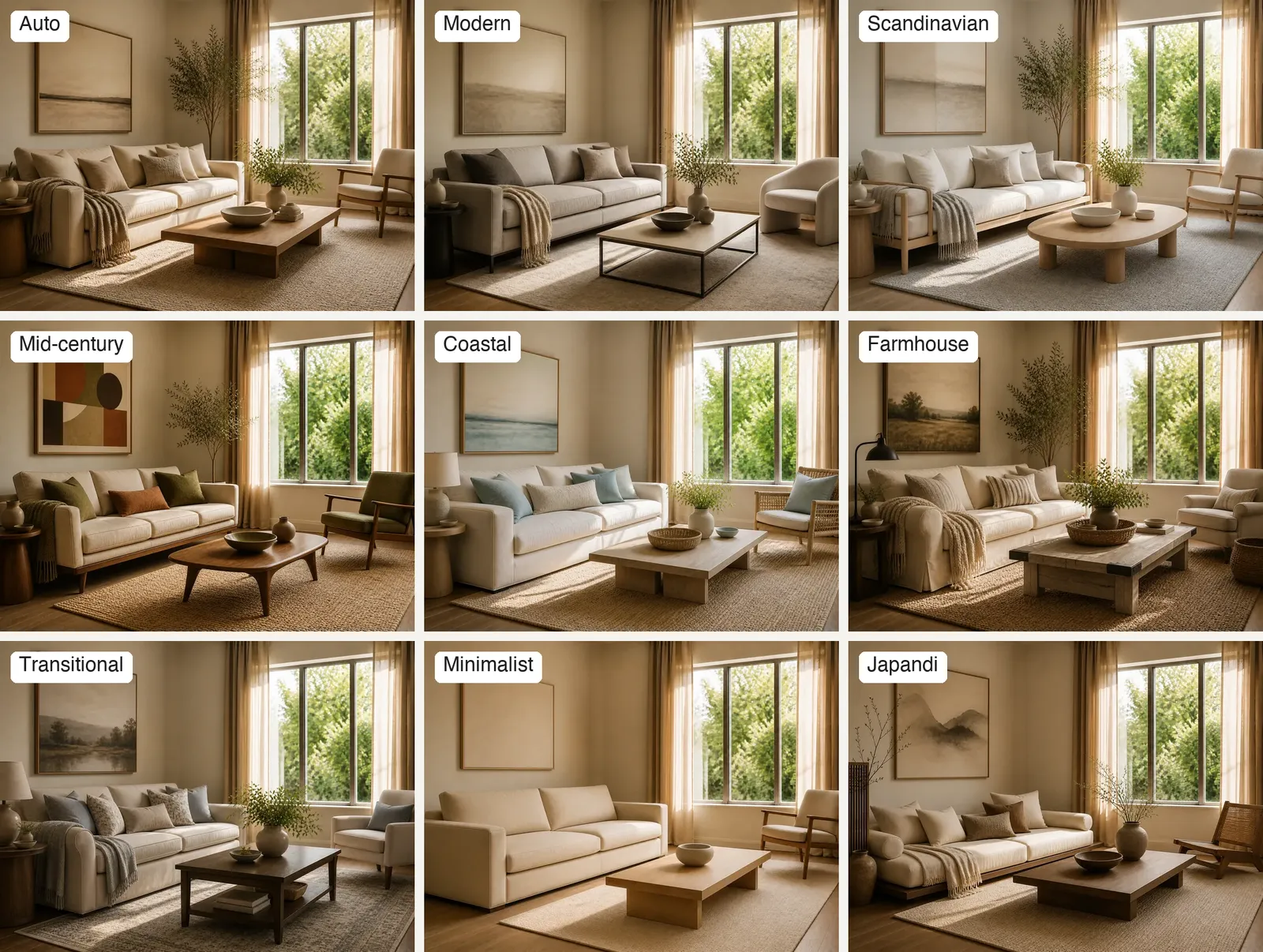
So this guide does it differently. The eight styles you can actually pick from in Domicco are shown on one room, the same photo every time, so the only thing that changes between the pictures is the style. The twelve or so styles we do not render yet are explained with the same three questions: how do you recognise it, who is it for, and where does it stop and the next one begin.
If you came here because a salesperson asked what your style is and you did not know, skip to the section on finding your style. It does not involve a quiz.
The interior design styles list, and how to tell them apart
Twenty styles cover almost every room you will see on a listing, in a magazine or in a friend's house. The list is built for the moment you are standing in a room and want a name for it: read the middle column first, then check the cousin, because the cousin is usually what you were about to call it.
The first eight are the styles you can try on a photo of your own room, and each one gets its own section below.
| Style | How to recognise it | Closest cousin |
|---|---|---|
| Modern | Straight lines, clear surfaces, no ornament | Contemporary |
| Scandinavian | Pale wood, white walls, one soft throw | Japandi |
| Mid-century | Walnut and teak on thin tapered legs | Modern |
| Coastal | Sea blue and white with rattan or rope | Scandinavian |
| Farmhouse | White painted timber with black metal | Rustic |
| Transitional | Classic sofa shapes in plain fabric | Traditional |
| Minimalist | Empty floor and empty walls on purpose | Modern |
| Japandi | Low dark wood, cream and clay tones | Scandinavian |
Twelve more home interior design styles
These twelve are not style controls in the tool yet, but people live in them and mix them into the first eight all the time. The ones with the most followers get a section of their own further down.
| Style | How to recognise it | Closest cousin |
|---|---|---|
| Contemporary | Curves, one bold accent, this year's showroom | Modern |
| Traditional | Dark wood, pattern, two of everything | Transitional |
| Rustic | Raw wood that still shows its knots | Farmhouse |
| Cottage | Florals and painted furniture, cosy | Farmhouse |
| Boho chic | More pattern and plants than any other | Eclectic |
| Industrial | Brick, steel and pipes left on show | Rustic |
| Art deco | Fan shapes, gold, lacquer and velvet | Traditional |
| Mediterranean | Warm plaster, an arch, a tiled floor | Spanish |
| Spanish | Dark beams and painted tile on white | Mediterranean |
| Craftsman | Wide wood trim and built in cabinets | Rustic |
| Victorian | Pattern on pattern under heavy mouldings | Traditional |
| Eclectic | Nothing matches, one colour repeats | Boho chic |
Modern interior design styles: modern, contemporary, minimalist, mid-century, Scandinavian and Japandi
Six of the twenty styles belong to one family. They share a distrust of ornament, a preference for plain surfaces, and an attitude that a room should look calm before it looks impressive. If you like clean lines but cannot say which of these six you want, the differences are mostly warmth and weight: how much wood is in the room, how dark it is, and how low the furniture sits.
Five of the six are styles you can run on a photo of your own room in Domicco. Contemporary is the exception, and its section explains why.
Modern
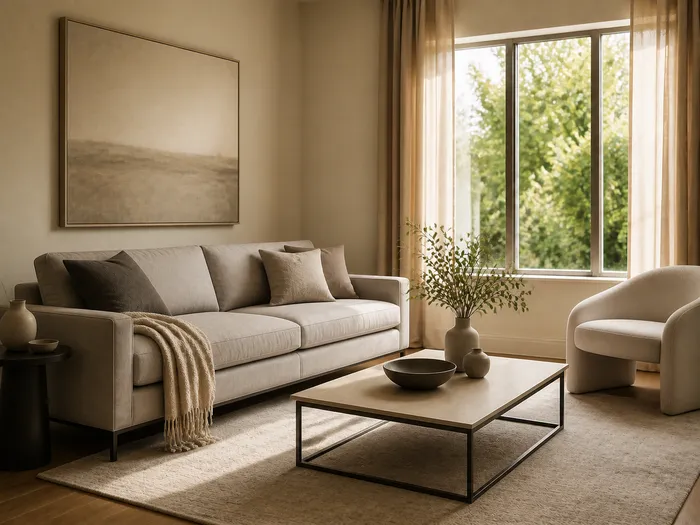
Modern is the plainest of the family. Straight lines, low furniture, smooth surfaces and a palette that stays within white, grey, black and one earth tone. Nothing on the coffee table, nothing on the walls that does not have a job. The style comes from the first half of the twentieth century. You do not need the history to recognise it: if every edge in the room is straight and every surface is clear, it is modern.
It suits rooms that already have good bones and good light, because modern gives you nowhere to hide. A boxy room with one big window is a natural fit. A room with awkward angles, radiators and a lot of doors tends to fight it.
Where it stops: add a curve, a saturated accent colour or a sculptural light and you have crossed into contemporary. Take furniture away until only the essentials are left and you have crossed into minimalist.
Contemporary, and why it is not the same thing as modern
Contemporary means whatever is current, so it never settles. Right now it means a neutral base, one bold colour, curved sofas, mixed materials (a stone table on a metal base, a boucle chair next to a glass lamp) and lighting that is chosen to be looked at. In ten years it will mean something else and modern will still mean modern.
That is the whole difference, and the comparison table further down puts it beside three other pairs. The short version: modern is a fixed set of rules, contemporary is a snapshot of the present.
We do not offer contemporary as a style control for exactly that reason. A style that changes every season would give you a different room every time the model was updated. If you want a contemporary result, run Modern and add one accent colour and one curved piece in the note.
Minimalist
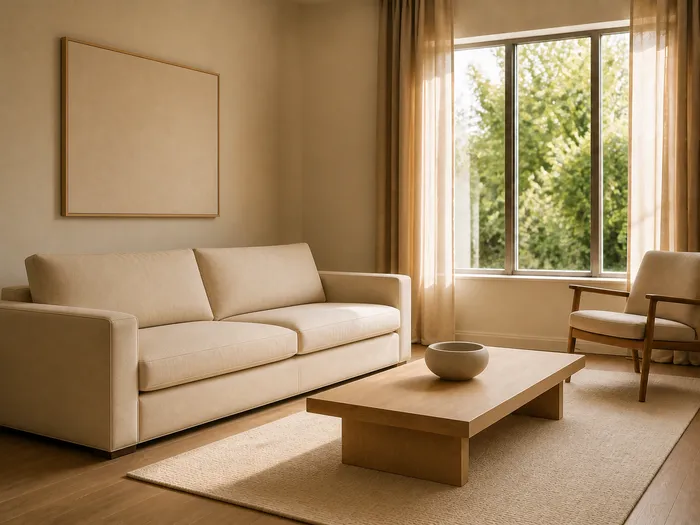
Minimalist is modern with the volume turned down. Two or three tones, almost all of them light. A handful of pieces, each of them plain. Generous empty floor and at most one quiet accent. The room is finished when there is nothing left to remove.
It suits people who find visual noise tiring and rooms that are small, because empty floor reads as space. It punishes clutter immediately: a minimalist room with a week of mail on the side table stops being minimalist.
Where it stops: introduce warm wood, low furniture and a clay or charcoal tone and you have moved into Japandi. Introduce pale wood and soft textiles and you have moved into Scandinavian. Both are minimalist rooms with more warmth.
Mid-century
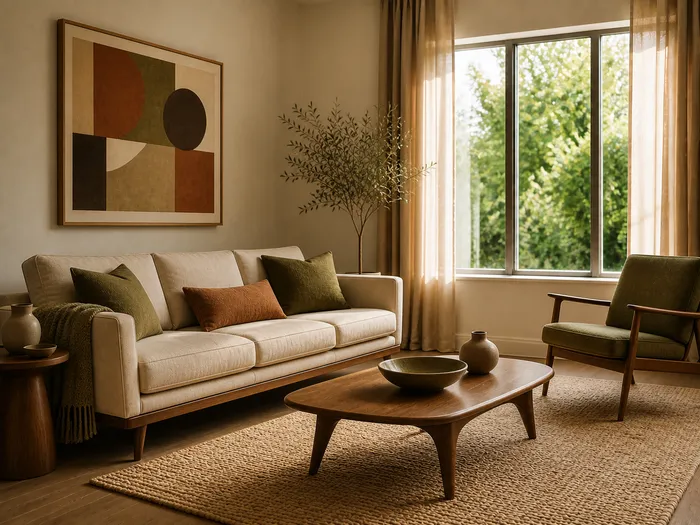
Mid-century modern is the warm branch of the family. Walnut and teak, tapered legs, organic curves on chairs and tables, and a palette of olive, mustard, rust and teal against neutral walls. The furniture stands on thin angled legs, so you can see the floor under almost everything, and the room feels light even with dark wood in it.
It suits rooms with wood floors and a mix of old and new pieces, and it is forgiving about the odd inherited chair, because the style was built around a few iconic shapes and never needed matching sets.
Where it stops: cool the wood down to blond and swap the olive and rust for white and grey and you are in Scandinavian. Remove the colour and the curves and you are back in modern.
Scandinavian
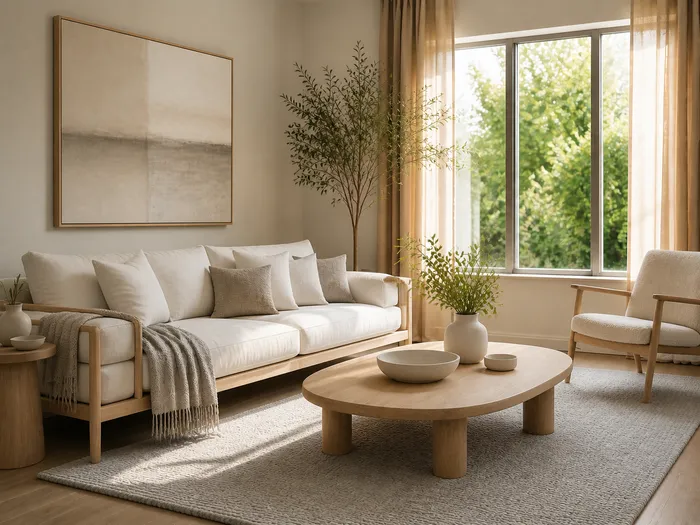
Scandinavian was built for long dark winters, so it works well in rooms that do not get much light. White walls, pale grey, blond wood floors, simple furniture shapes, and softness everywhere the eye lands: wool throws, linen cushions, a sheepskin over a chair. The tell is pale wood plus white plus one soft textile.
It suits small rooms, north facing rooms and anyone who wants calm without coldness. It is also the most forgiving style in the family for a room that has to be lived in, because textiles hide a lot.
Where it stops: darken the wood, lower the furniture and swap the white for cream and clay, and it becomes Japandi. Take the textiles away and it becomes minimalist.
Japandi
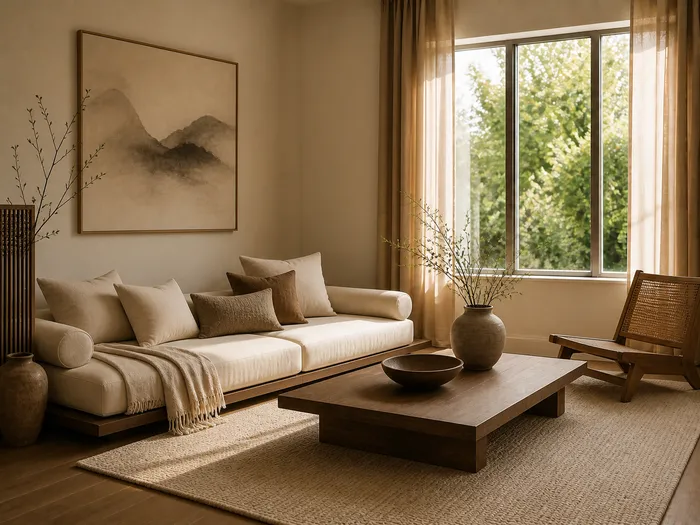
Japandi is what happens when Japanese restraint meets Scandinavian warmth. Low furniture, wood slats, cream and clay tones, paper and stone, and a lot of deliberate empty space. It is quieter than Scandinavian and warmer than minimalist, and it is the one style in the family that looks better the fewer things you own.
It suits rooms with a low ceiling, because everything in the style sits low, and it suits people who already lean minimalist but find pure white rooms cold.
Where it stops: raise the furniture and lighten the palette and it is Scandinavian again. Add a second accent colour and it stops being Japandi, because the style depends on the palette staying tight.
Popular interior design styles in 2026: transitional, farmhouse, coastal, traditional, boho and industrial
Outside the modern family, the styles people actually live in are the warm ones. Transitional is the most common style in American homes, usually without anyone calling it that. Farmhouse has led the decorating charts for the better part of a decade. Boho chic has the widest following of any single style. Industrial and rustic are what people reach for when a room has a hard surface they cannot hide.
Three of these (transitional, farmhouse and coastal) are styles you can run on your own photo. The other four are explained with the same three questions so you can recognise them and see how they relate to the ones you can render.
Transitional
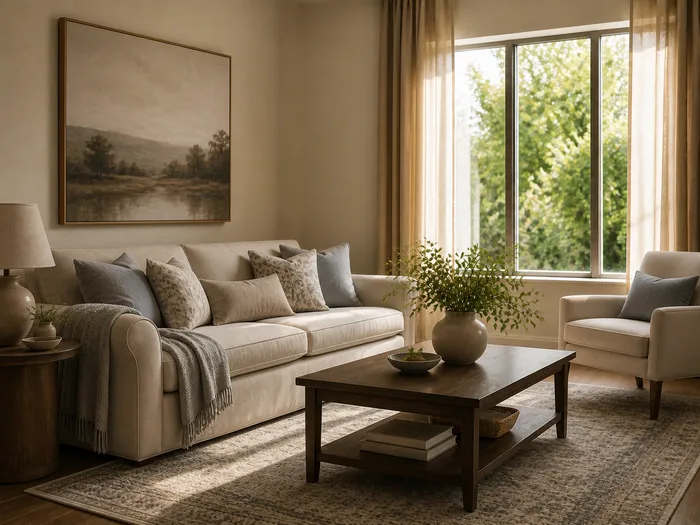
Transitional is the middle of the road, and that is a compliment. Classic furniture silhouettes (a rolled arm sofa, a wing chair, a turned leg table) in plain fabrics and current colours, with none of the carving and pattern of traditional and none of the starkness of modern. The palette is warm neutrals: cream, taupe, greige, soft grey.
It is the safest style to buy into if you are not sure, because almost anything you already own fits in it, and it is the one most likely to still look right in ten years. It suits family rooms, rooms with mixed hand me downs, and anyone who found traditional too stuffy and contemporary too much.
Where it stops: add pattern, dark wood and matched pairs and it becomes traditional. Strip the classic shapes out and use only straight lines and it becomes contemporary.
Farmhouse
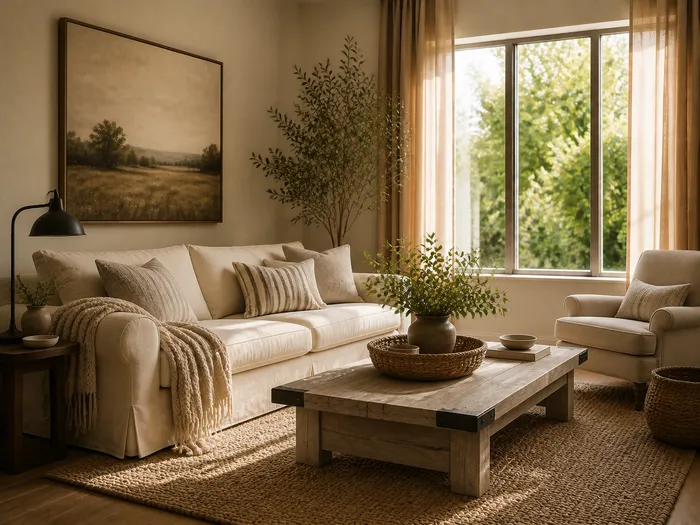
Modern farmhouse, the version most people mean by farmhouse now, is white painted timber, shiplap or board walls, black metal accents, woven textures and a lived in warmth. The giveaway is black against white: black window frames, black hardware, a black metal light fitting over a white painted table.
It suits rooms with any wood in them, rooms that have to survive children and dogs, and kitchens above all. It is the one style in this list that looks better slightly worn.
Where it stops: let the wood go raw and the metal go rusty and it becomes rustic. Swap the black accents for florals and pastels and it becomes cottage. Both are close relatives, and the mixing section later explains how to keep them from arguing.
Coastal, and the coastal grandma version
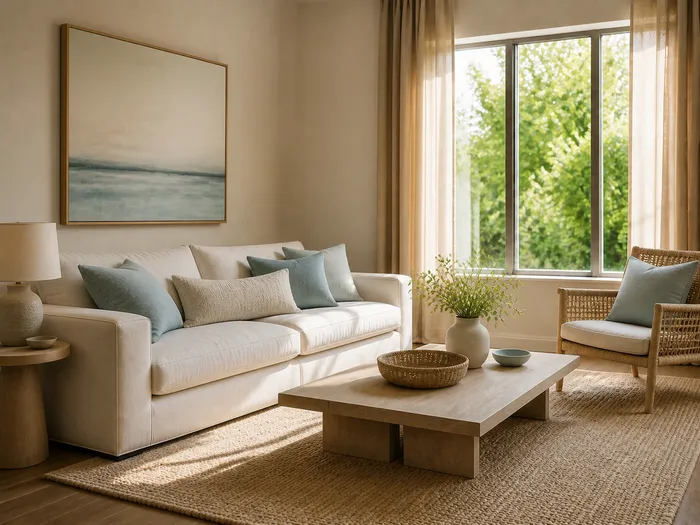
Coastal is light wood, off-white and sea blue, natural fibres and an airy feel. Rattan, jute, linen, glass, and a palette that stays in sand and water colours. Skip the beach props: no seashells on the shelf, no anchor on the wall. The tell is blue and white with rope or rattan and nothing that says beach out loud.
Coastal grandma, the version that went around a few years ago, is the same palette with more linen, more white, more ceramics and more comfort. It is coastal for a house that is lived in all year.
It suits rooms with a lot of daylight, rooms near water obviously, and rooms in cities where you want the feeling of water without the view. It stops being coastal the moment the blue turns navy and the wood turns dark, at which point it is closer to traditional.
Traditional
Traditional is the style most people picture when they hear the word interior design. Dark wood, deep rich colours, ornate detail, symmetry and matched pairs: two lamps, two armchairs, two side tables, all arranged around a centre line. Patterned fabrics, crown moulding, a rug with a border.
It suits older houses with the mouldings already in place, formal living rooms and dining rooms, and people who want a room to feel finished and permanent. It is the hardest style to do on a budget, because the detail is the point and cheap detail shows.
Where it stops: simplify the fabrics and lighten the wood and it becomes transitional. Pile on more pattern and more carving and it tips into Victorian.
Boho chic
Boho chic is the easiest style on the list to recognise: more pattern and more plants than any other. Layered rugs, layered textiles, rattan and cane, global patterns, macrame, warm earth tones with jewel colour accents, and the sense that everything in the room was collected over years.
It suits people who own a lot of things they love, rented rooms where you cannot change the walls, and anyone whose style keeps changing, because boho absorbs new pieces without complaint.
Where it stops: take the pattern down and keep the mix of eras and it becomes eclectic. Take the plants and rattan away and keep the pastels and florals and it becomes cottage. The boundary with eclectic is the fuzziest in this whole list, and the FAQ has a line on it.
Industrial
Industrial is the style that leaves the building's structure on show. Exposed brick, steel, concrete, reclaimed wood, visible pipes and ducts, big factory style windows, and a palette of grey, black, rust and raw brick red. Furniture is heavy and simple: a leather sofa, a steel and wood table, metal stools.
It suits lofts and converted buildings, obviously, but it also suits any room with a hard surface you cannot hide. A concrete floor, a brick chimney breast or a steel beam that would be a problem in a farmhouse room is the starting point of an industrial one.
Where it stops: soften the metal into painted timber and it becomes farmhouse. Warm the palette up with raw wood and stone and it becomes rustic. Keep the plain surfaces but hide the structure and it becomes modern.
Rustic, and where it stops being farmhouse
Rustic is wood that still shows where it came from. Bark, knots, saw marks, reclaimed beams, stone, leather, iron. The palette is browns, greys and forest greens, and nothing is painted white. Farmhouse is the cleaned up and painted version of the same barn.
It suits cabins, mountain and lake houses, and any room with a fireplace and heavy beams. It is heavy by nature, so it wants a big room or a high ceiling.
The line with farmhouse is the paint. Farmhouse paints the timber white and adds black metal; rustic leaves the timber raw and adds iron and leather. If you like the warmth of rustic but your room is small, farmhouse is usually the better answer, and it is one of the eight styles you can try on your photo.
Modern vs contemporary interior design, and three other pairs people mix up
Modern versus contemporary is the most common confusion in interior design, because in everyday English the two words mean the same thing. In design they do not. Modern is a specific set of rules from the twentieth century: straight lines, plain surfaces, function first, a restrained palette. Contemporary is whatever is current, which today includes curves, mixed materials and one bold accent, and which will include something else in a decade.
Three other pairs cause almost as much trouble, and they are the ones people ask about on Houzz when they post a photo of their own room. Each pair shares a lot; the table gives the one thing that separates them and which to pick for your own photo.
| Pair | The one difference | Pick this if |
|---|---|---|
| Modern vs contemporary | Modern has no curves and no strong colour and never changes. Contemporary has both and changes every few years | Modern for a room that still looks right in ten years. Contemporary for a room that looks like now |
| Farmhouse vs rustic vs cottage | Farmhouse paints the wood white. Rustic leaves it raw. Cottage adds florals and pastels | Farmhouse for a family room or kitchen. Rustic for a big room with beams. Cottage for a small, soft room |
| Scandinavian vs Japandi vs minimalist | Scandinavian is pale wood and soft textiles. Japandi is lower and darker. Minimalist drops the textiles and most of the wood | Scandinavian for a dark room. Japandi for a low ceiling. Minimalist if you own very little |
| Transitional vs traditional | Traditional keeps the pattern, dark wood and matched pairs. Transitional keeps the shapes and drops the rest | Transitional for almost everyone. Traditional if the house has the mouldings |
What is my interior design style? A way to find out without a quiz
Most style quizzes ask you to pick between twelve stock photos of rooms that are not yours, then ask for your email before they tell you the answer. The answer is a label, and the label tells you nothing about whether your living room, with its radiator under the window and its awkward door, will actually look good in that style.
A Houzz poster put the real problem better than any quiz: they loved many different decorating styles, and when salespeople asked what their style was, they never knew what to say. The replies pointed out that their style was more consistent than they thought once you looked at what they kept choosing. That is the method. Put your own room in three styles and watch which one you keep coming back to.
Here is how to do it with one photo and a few minutes.
Photograph the room you spend the most time in
One photo, from the doorway or the corner, with the lights on and the curtains open. Do not tidy for it beyond moving the obvious clutter; the styles will replace the furnishing anyway, and the walls, windows and light stay as shot, so what you are testing is how each style sits in your actual room.
Pick three styles that are far apart
Not three neighbours. Choose one from the modern family, one warm style and one wildcard: Minimalist, Farmhouse and Mid-century, for instance, or Japandi, Transitional and Coastal. The point of the first round is to find which family you belong in, not which member of it.
Run all three on the same photo
Upload the photo once on the AI interior design page, pick the room type, and run it in each of the three styles. Every result stays in your library, so you can put them side by side in the next step. The signup credits cover the first render, and the pricing page lists what the plans include after that.
Compare them side by side and notice what you keep looking at
Open the three results in your library next to each other. Ignore which one is prettiest in the abstract. Ask which one you would actually walk into on a Tuesday evening. People almost always keep returning to one result within a minute, and it is often not the one they expected to like.
Run the winner's two closest cousins
Take the style you kept looking at and run the two beside it in the list above. If Farmhouse won, try Coastal and Transitional. If Minimalist won, try Japandi and Scandinavian. The second round finds the exact style; the first round only found the family. You now have a name for your style and three pictures of your own room in it.
An interior design style quiz with no email
If you want a quiz anyway, here is one with five questions, no email and no stock photos. Answer honestly and each answer points at a section above.
One. Your coffee table right now: if it is empty, you lean Modern or Minimalist. If it has a plant, a book and a candle, you lean Scandinavian or Coastal. If it has five things and a throw over the sofa behind it, you lean Boho or Cottage.
Two. The wood you would choose for a dining table: pale and smooth points to Scandinavian. Walnut with tapered legs points to Mid-century. Painted white points to Farmhouse. Raw with the edge still on it points to Rustic. Dark and carved points to Traditional.
Three. Colour: a room with no colour at all is Modern or Minimalist. One bold accent is Contemporary. Warm neutrals only is Transitional or Japandi. Sand and sea blue is Coastal. Jewel tones on earth tones is Boho.
Four. What you would do with an exposed brick wall: paint it white is Farmhouse or Scandinavian. Leave it is Industrial. Plaster over it is Modern. Hang three rugs on it is Boho.
Five. How you feel about symmetry: two of everything is Traditional. Two of the big things and nothing else matched is Transitional. Nothing matched on purpose is Eclectic. If you never thought about it, run the three style test above.
Interior design styles by room: living room, bedroom, kitchen and bathroom
A style does not land the same way in every room. The living room shows the most difference between styles, the bedroom is where the quiet styles win, and the kitchen and bathroom have fixed surfaces that limit which styles are honest. The AI interior design tool has a separate control for each of these room types, because the furnishing rules differ, and these notes are about which styles suit which room before you run anything.
Kitchens favour the styles with a strong material identity: Farmhouse (white painted timber and black hardware), Modern (flat fronts, no handles), Scandinavian (pale wood and white) and Industrial (steel and open shelving). Boho and Traditional kitchens exist but they are harder to keep clean looking, and Minimalist kitchens only work if you have somewhere else to keep everything.
Bathrooms are the most constrained room because the tile and the fittings usually stay. Coastal, Scandinavian, Japandi and Modern all work with white tile. Mediterranean and Spanish are the styles that make patterned tile look intentional. Farmhouse bathrooms work when there is any wood or shiplap to hang the style on.
Modern style living room design
The living room is where the modern family shows its differences most clearly, because it has the most furniture to show them with. A modern living room is low, straight and empty of ornament: a low sofa, a plain rug, one lamp, one piece of art. A contemporary living room takes the same base and adds a curved sofa and one accent colour. A mid-century living room adds walnut, tapered legs and an olive or mustard chair.
If you are running a living room photo through the tool, this is the room type where Modern, Mid-century and Japandi differ most from each other, so it is the best room to use for the three style test above. It is also the room where Auto, the neutral default, is most useful as a baseline before you commit to a named style.
Bedroom interior design styles
Bedrooms reward the calm styles. Scandinavian, Japandi, Minimalist and Coastal are the ones people keep after trying several, because a bedroom is the one room where you do not want the style to demand attention. Transitional works for a bedroom that has to hold a lot of furniture. Boho works for a bedroom that is also where you read, work and keep your plants.
In the tool, the bedroom control anchors the room on the bed and builds out from it, so the styles that treat the bed as a low, quiet centre (Japandi in particular) tend to give the most convincing bedroom results, and the styles that rely on a lot of standing furniture give the least.
Mixing interior design styles without the room looking like a showroom floor
Almost nobody lives in one pure style, and the Houzz poster who loved many styles was not doing anything wrong. Mixing is normal. What goes wrong is mixing without a rule, so the room reads as a furniture showroom where each piece came from a different display.
The rule that works is: one style for the big pieces, one style for the accents, and one colour that appears in both. Transitional sofa and chairs with mid-century side tables and lamps, tied together by the same olive green in a cushion and a lamp base. Farmhouse kitchen with industrial stools and lighting, tied together by black metal. Scandinavian base with boho textiles, tied together by one terracotta tone. The big pieces set the family, the accents add the personality, the shared colour tells the eye it is one room.
Two mixes almost never work: styles from different families at the same scale (a traditional carved sofa beside a modern glass table, both fighting to be the biggest thing in the room), and two ornate styles together (Victorian and boho, or traditional and art deco), because there is nowhere for the eye to rest. If you want to test a mix on your own room, run the base style in the tool, then name the accent style and the shared colour in the note, and let the result tell you whether the two agree.
How to choose an interior design style for a room you already live in
Finding your style and choosing a style for a room are two different questions, and the Quora threads on how to choose between the many interior design styles conflate them. Your style is what you are drawn to. The right style for a room is what your style looks like once the room's fixed facts have had their say. Three facts decide most of it.
Light decides the family. A room that gets a lot of daylight can carry the dark, heavy styles: traditional, rustic, industrial, mid-century with dark walnut. A room that does not should stay in the light styles: Scandinavian, coastal, minimalist, farmhouse. This is the single most common mistake in the three style test: people pick the style they love from pictures of sunlit rooms and run it on a north facing room, and it comes back gloomy.
Size decides the weight. Small rooms want low furniture and empty floor (Japandi, minimalist, Scandinavian) or a style that makes clutter look intentional (boho, cottage). Big rooms can carry rustic, traditional and industrial, which all need volume to breathe.
What you already own decides the rest. If you are keeping the sofa, the style has to be one the sofa belongs to, and transitional is the style most sofas belong to. If you are keeping a dark wood dining table, mid-century, traditional and rustic are honest options and Scandinavian is not. The way to test this is to run the style you want, then pin the pieces you are keeping with a reference image and see whether the style survives them.
Interior Design Styles FAQ
Depends who is counting. HGTV lists more than forty, most guides settle around twenty, and this one uses twenty because past that point the additions are variants of a style already on the list (coastal grandma is coastal, modern farmhouse is farmhouse, Scandi boho is a mix). Eight of the twenty are available as style controls in Domicco, and those eight cover the families most rooms end up in.
There is no best, but there is a safest: transitional, because almost anything you own fits in it and it dates slowly. The most followed is boho chic. The most common in new homes in 2026 is modern farmhouse. The one people most often keep after trying several on their own room is Scandinavian, because it forgives clutter and works in poor light.
A style is a set of rules about materials, shapes and colours that has stayed stable long enough to have a name (Scandinavian, art deco). An aesthetic is usually a mood with a nickname that spreads online (coastal grandma, cottagecore, dark academia). Most aesthetics map onto one of the twenty styles here with a colour shift; coastal grandma is coastal with more linen, cottagecore is cottage with more florals.
You find out by looking at what you keep choosing. The section above walks through it: photograph your own room, run three styles that are far apart, see which one you keep looking at, then run its two neighbours. It takes one photo and a few minutes, and you end up with pictures of your own room in the answer.
The five question one above asks for nothing and links each answer to a section on this page. The reason most quizzes want an email is that the quiz is a lead form for a design service; the answer is the same label either way.
This is a question from a quiz answer key that circulates online. In a real room, woven water hyacinth baskets read as coastal when they sit with white and sea blue, as boho when they sit with pattern and plants, and as farmhouse when they sit with painted timber. What is around the basket decides the style.
Yes, and most lived in rooms do. Keep one style for the big pieces, one for the accents, and one colour that appears in both. The mixing section above has three combinations that work and two that almost never do.
Partly. Paint, textiles, lighting and rugs shift a room one step along the list (transitional to traditional, Scandinavian to Japandi) without touching the furniture. Two steps or a change of family usually needs at least the sofa to change, because the sofa is the piece that sets the style. Running the target style on a photo of the room, with the furniture you are keeping pinned as a reference, shows you before you spend anything whether one step is enough.
Boho is a style with its own palette (earth tones with jewel accents) and its own materials (rattan, layered textiles, plants, global pattern). Eclectic is a method, not a palette: pieces from several eras chosen on purpose and tied together by one repeated colour. A boho room is almost always eclectic; an eclectic room is only boho if the textiles and plants are doing the work.
Eight, plus Auto: Modern, Scandinavian, Mid-century, Coastal, Farmhouse, Transitional, Minimalist and Japandi. Auto is a neutral, broad appeal starting point for when you do not want to name a style yet. The tool page lists them with the same tile images used in this guide.
It keeps the camera angle, the walls, the windows and the light as they are in your photo, and it changes the furnishing to the style you chose. Three results from one photo differ only in style.
You get free credits at signup, which cover your first render. After that each render is five credits, and the plans on the pricing page start at $19.99 a month. Every result stays in your library so you can compare styles from different sessions.
One shot from the doorway or a corner, lights on, curtains open, taken at standing height. Wide enough to show the floor and at least two walls. The tool replaces the furnishing, so you do not need to stage the room, but a photo taken in daylight gives every style a fairer chance than one taken at night.
Because contemporary means whatever is current, and a style control that changed with fashion would give you a different room every time the model updated. Modern is the fixed version of the same instinct. If you want a contemporary look, run Modern and add one accent colour and one curved piece in the note.
Sources and References
- HGTV, 40+ Interior Design Styles, Defined (accessed 2026-09-14)
- Decorilla, Interior Design Styles 101: The Complete Guide (accessed 2026-09-14)
- Havenly, Interior Design Types and Styles Guide (accessed 2026-09-14)
- Decorilla, Modern vs Contemporary Interior Design Style (accessed 2026-09-14)
- Havenly, Mix Interior Design Styles: 18 Combinations (accessed 2026-09-14)
- Houzz forum, [PICTURES] What's my style? (accessed 2026-09-14)
- Quora, Is it possible to mix styles in interior design? (accessed 2026-09-14)
See these styles on a room of your own
Editorial, Domicco
We build Domicco and we run everything we write about here, on the same plans and the same credits as everyone else.
Try eight of these on your own room
One photo, eight styles, every result kept in your library to compare. Free credits at signup cover your first render.